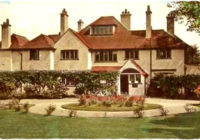
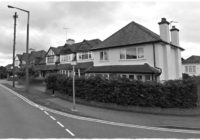
The large late Victorian property at 1 Cobham Road, Westcliff-on-Sea, Essex, has seen numerous changes in ownership and occupancy since its construction as a private residence in 1899. Situated on the corner of The Leas and Cobham Road, the building offers expansive views across the estuary. Today, it is home to Shebson Lodge and the Southend Jewish Community Centre.
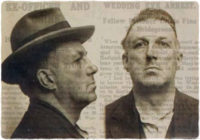
From time to time I scan the newspaper archives for mention of interesting historical stories from my hometown of Hadleigh, Essex from the same month. February’s search threw up what at first appeared to be an amusing story of a Hadleigh bridegroom’s over-exuberance in London on the eve of his wedding causing him the need to beg for money to get back home. What I went on to uncover were three generations of well-respected railway engineers, and a clever man’s life blighted by alcohol and the after-effects of a head injury sustained during WWI.
The fields at Belfairs Farm in Leigh, Essex were created by clearing woodland owned by Lady Olivia Bernard SPARROW between 1804-1842 and there is evidence to suggest there had been a farm there to manage the woods since the 13th century. The land was originally part of the holdings of Leigh Manor, not changing until the death of Lady Sparrow in 1863 when her estates were sold and can be traced back through the family to Richard RICH, 1st Earl of Warwick, who acquired it from Henry CAREY, 1st Baron Hudson in the mid-16th century.
The Hoy & Helmet, formally Hoy Inn, is a Grade II listed building on the High Street as it curves down towards South Benfleet train station. It comprises of several buildings; the middle section is thought to date back to the 15th century (once a house), and the right section nearer the church was added in the 18th century. The Hoy & Helmet retains much of its old-world charm to this day, with its higgledy-piggledy layout of rooms the setting of many a tale over the last five hundred years, two hundred of which are detailed within these pages (including smuggling, assault, death by gin and suicide).
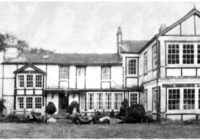
Bramble Hall once stood in the uppermost northeast of the parish of Hadleigh, with its farmland extending just over the border to the west into Thundersely, next to Daws Heath village. Its land was surrounded to the east and south by Hadleigh Great Wood, just north stood Garrolds Farm at the very top of the parish, and the farmland to the west abutted Haresland Farm. Rumours have abounded for many years as to the age, origin and status of Bramble Hall, with many believing it to date back to the early 15th century and part of the ancient Manor of Hadleigh with its many royal connections. Rumours have abounded for many years as to the age, origin and status of Bramble Hall, with many believing it to date back to the early 15th century and part of the ancient Manor of Hadleigh with its many royal connections. How do these stories hold up under further scrutiny and who were its owners and occupants?
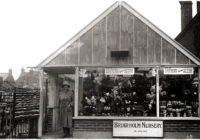
In July 2022 I helped the owner of a newly acquired black and white photograph to pinpoint exactly where it was taken on London Road, Hadleigh, Essex. The photo captured Miss Margaret Blake standing outside her gardening business “Briarholm Nursery” in the late 1920s or 1930s. Always eager to learn more, I went on to research Margaret’s family tree and discovered her mother’s side had a fascinating history including quack doctors, printers, artists and house builders.
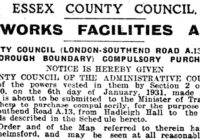
On the 6th Jan 1931 Essex County Council made a Compulsory Purchase Order for the strips of land on either side of London Road, Hadleigh, Essex in order to widen and improve the old road heading into Leigh-On-Sea. A full list of all affected properties was published in the Chelmsford Chronicle on 6th Feb, complete with the names of the owners and occupiers, how much land was to be purchased and its current use.
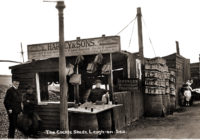
Nestled along the tidal edge of Leigh Creek, the cockle sheds of Old Leigh have long stood as weathered sentinels of a once-thriving fishing community. Among them, No. 1 Cockle Shed holds a particularly rich history, one that traces not only the evolution of the local shellfish trade but also the enduring legacy of the Harvey family, who worked these shores for generations.
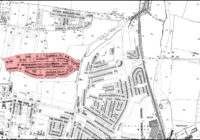
Feeches Farm was situated on Rochford Road, Eastwood, Essex up until the early 1920s, and encompassed 35 acres of arable and pasture land (and originally two fields names named Great Feeches and Little Feeches). The rough oval-shaped plot was historically situated on the very southeast corner of Eastwood borough but now falls into the Prittlewell district of Southend-On-Sea, with Southend Airport just to the north.
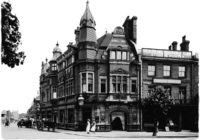
The Railway Hotel is situated at the end of Clifftown Road, in the Cliff Town Conservation Area of Southend-On-Sea, Essex. The building and business date from circa 1868 and traded almost continually until its closure in April 2021.
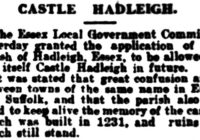
In Jan 1913, outspoken local Councillor Edgar Arthur Mundy and current Chairman of the Hadleigh Ratepayers’ Association, began a debate regarding the post being wrongly delivered to Hadleigh, Suffolk rather than Hadleigh, Essex. Mundy’s solution was to change the name of the village to “Castle Hadleigh”, to reflect both its castle ruins and historical past and to clearly define it from Hadleigh in Suffolk. The debate lasted for nearly nine months (ending in rejection), but was never completely dropped by Mundy until WWI began.
Charles William John LINCE was born 1887 in Ramsden Bellhouse, Essex. He enlisted c.1916 in the Middlesex Regiment (Duke of Cambridge’s Own), and became missing in action and presumed dead on 22 Sep 1917 age 30.
Alfred GINN was born Jan 1872 in St. Neots, Huntingdonshire. He enlisted on 5th Sep 1889 into the 3rd Hussars and fought in the Boer War with the 6th and 2nd Dragoons. He was discharged after 21 years service in 1910 and re-enlisted 25th May 1915 as a 2nd Warrant Officer for the Military Mounted Police Corps. Alfred was killed in action just under 4 months later on 1st Oct 1915 age 43, leaving a wife and three young children.
An interesting bit of detective work presented itself to me at the end of August on a local Facebook page for Hadleigh, Essex. A local chap named Ron had been digging a large hole in his garden in order to insert a sunken trampoline for his grandchildren, when two feet down he unearthed a silver medal. Closer inspection revealed it to be a King George V naval Long Service and Good Conduct medal for a G W BRERETON. Ron wondered if any members of the Brererton family were still living in the area in the hopes of being able to pass it on back to them, and I decided to help.
Alfred GILBERT was born 9th Apr 1879 in Barningham, Suffolk. He enlisted 2nd Dec 1914 as a Private in the Essex Regiment (1st Battalion), and became MIA then confirmed killed on 6th Aug 1915 aged 36. He left behind a wife and four children.
Robert James FEAKINS was born 1897 in Hadleigh, Essex. He enlisted underage into the 2/6th Essex Regiment in Nov 1914, later transferred to the King’s Own Yorkshire Light Infantry (7th Battalion). He was killed in action on 7th Oct 1916 age 19.
Thomas Henry FARLEY was born 1897 in Southend-On-Sea, Essex. He was fostered into the BARNES family in 1902, and lived in Hadleigh, Essex until 1914 when he was send to Canada. He enlisted in the 1st Canadian Labour Corps on 20th Apr 1916 and died from wounds on 19th Aug 1917 age 19.
Rayleigh Town Museum recently acquired this large 1m wide wooden sign for Beal Bros. Millers, Rayleigh and wondered if anyone could offer any more information on them.
After a conversation with a friend about his parents new house situated on the Rayleigh Road in Eastwood, Essex I decided to look into its history. It is oddly positioned next to a pair of semi-detached houses, an old well was found in the garden and there are hints of it being part of a bigger piece of land at one time. What could I find out?
Charles EADE was born 5th May 1895 at Weeley Heath, Essex. He enlisted into the 2nd Bedfordshire Regiment on 24th Aug 1914 and died of wounds on 16th Jun 1915 (only eight days after arriving in France). He was 20 years old.